


Many home cooks wonder if they can achieve that perfect, crispy-edged breakfast staple using their countertop convection oven. The short answer is yes, you absolutely can fry an egg in an air fryer, provided you use the right equipment and techniques to manage the unique environment of the appliance. While an air fryer is primarily designed for circulating hot air to mimic deep-frying, it can effectively mimic the experience of a stovetop skillet if you understand how to contain the egg and manage the intense airflow.
Because air fryers rely on rapid convection heat, you cannot simply crack an egg directly onto the metal basket, as it would fall through or create a massive mess. Instead, by utilizing specific accessories, you can produce a delicious result that rivals traditional cooking methods.
The Mechanics of Air Frying Eggs
To understand why air frying an egg requires specific tools, one must look at how the appliance functions. An air fryer is essentially a high-powered convection oven. It uses a heating element and a powerful fan to push air around the food.
When you place a raw egg into this environment, the air circulation is so intense that it can easily blow the liquid egg white off a flat surface or scatter it across the heating element. Furthermore, the non-stick coating of the basket is not designed to hold a liquid like a raw egg without it seeping into the mesh.
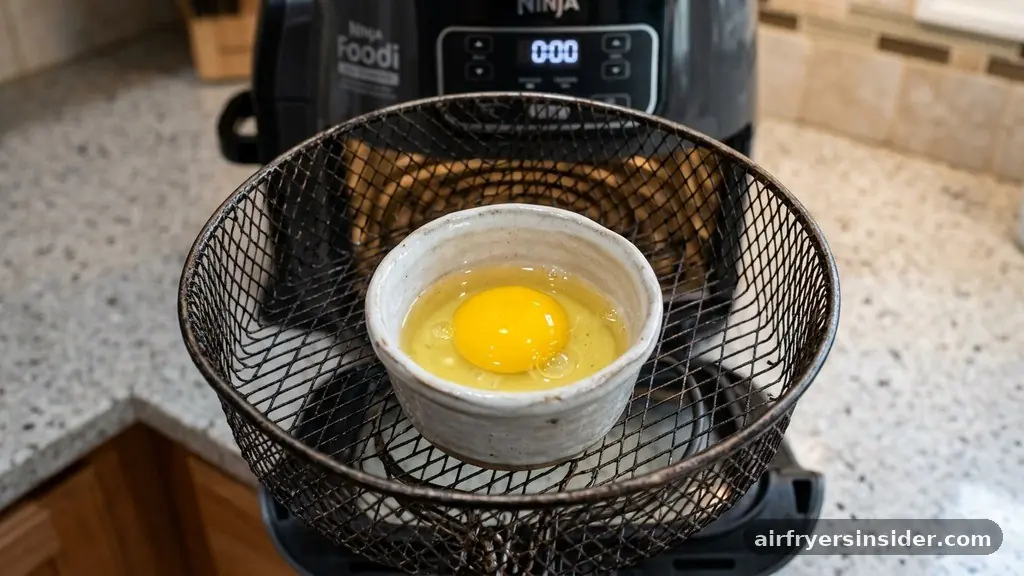
The key to success lies in creating a stable, contained environment. By using a small heat-safe vessel, you mimic the flat surface of a frying pan. This allows the egg to cook via the radiant heat of the container and the hot air circulating above it.
You are essentially baking the egg in a way that replicates the browning and protein coagulation found in a skillet. It is important to note that because the air is moving so quickly, the top of the egg will cook much faster than it would in a pan. This is why many people find that the yolk stays runny while the whites become perfectly set, provided the temperature and timing are dialed in correctly.
Essential Tools for Air Fried Eggs
You cannot simply toss an egg into the basket, so you need to invest in a few basic accessories. The most popular choice is a small silicone mold. Silicone is ideal because it is heat-resistant, flexible, and naturally non-stick.
You can find these in various shapes, though the classic round shape works best for sandwich-sized eggs. Another excellent option is a small ramekin or a ceramic dish.
These are excellent for those who prefer a more structured, deep-dish style of egg. If you choose to use ceramic, ensure it is oven-safe and small enough to fit comfortably in your air fryer basket without blocking the airflow entirely.
Beyond the vessel, parchment paper can be a lifesaver. While you might not use it inside the mold, a small piece of parchment placed at the bottom of the air fryer basket can help catch any accidental spills, making cleanup much faster. Additionally, always keep a high-quality cooking spray on hand.
Even with non-stick silicone or ceramic, a light coating of oil or butter spray helps ensure the egg releases easily and adds that desirable browning to the edges. Without this lubrication, you might find yourself scraping the bottom of your ramekin, which defeats the purpose of a quick and easy breakfast.
Achieving the Perfect Runny Yolk
If you love a runny yolk, the air fryer can be a bit of a challenge due to the intense top-down heat. To achieve that classic over-easy texture, you need to monitor your temperature settings closely.
Generally, cooking at a lower temperature—around 350°F (175°C)—is safer than cranking it to the maximum setting. High heat will cause the top of the egg to firm up and even brown before the yolk has a chance to warm through properly.
Another trick is the use of a splatter guard or a small piece of foil if your air fryer has a very powerful fan. Sometimes, the fan is so strong that it ripples the top of the egg, creating an uneven surface. By placing a small piece of foil over the ramekin for the first half of the cooking process, you can prevent the air from drying out the top of the egg too quickly.
Once the whites are mostly set, you can remove the foil to allow the edges to get those crispy, golden-brown bits that define a great fried egg. Remember that every air fryer is different; the wattage and the distance between the heating element and the basket will change your results, so keep a close eye on the egg during those first few attempts.
Managing Food Safety and Hygiene
When working with eggs, food safety is paramount. Eggs carry a risk of salmonella, and because the air fryer is a closed system that relies on air circulation, you must be careful not to contaminate the interior of the machine. If an egg spills, it can get into the fan or the heating element, which is difficult to clean and can lead to burnt odors in future meals.
Always ensure your vessel is stable and not filled to the brim. If you are using a silicone mold, place it on a small tray or a piece of foil before putting it into the basket to make it easier to transfer without tipping.
Furthermore, ensure that your eggs are cooked to an internal temperature that makes them safe to consume. While many enjoy a runny yolk, the white must be fully opaque and set to ensure proper protein coagulation.
If you are cooking for others, especially those with compromised immune systems, it is recommended to cook the egg until both the white and the yolk are firm. Clean your accessories thoroughly after each use, especially if you are using silicone, which can sometimes harbor bacteria if not washed with hot, soapy water.
Comparing Air Fryer Eggs to Stovetop Methods
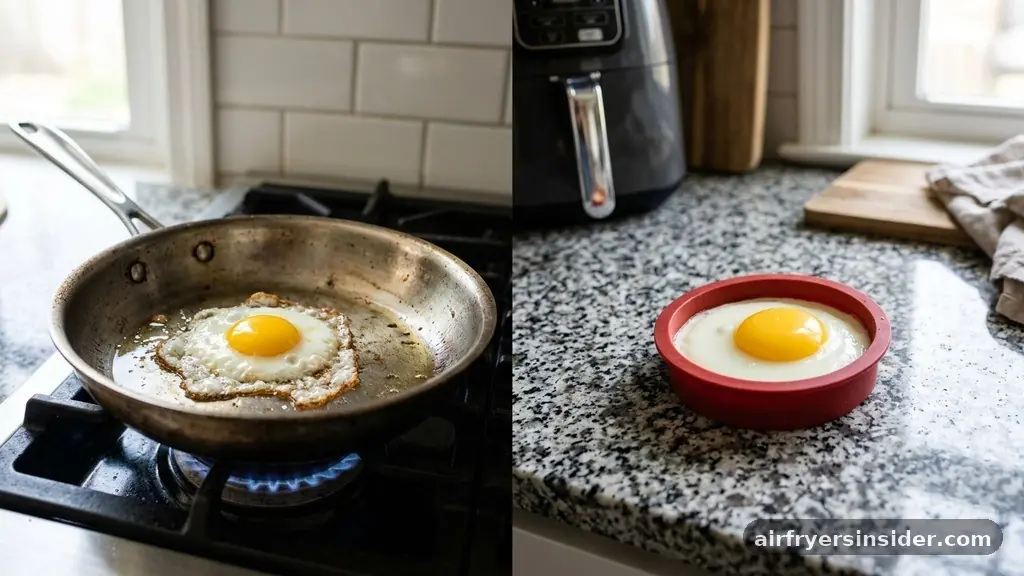
It is helpful to weigh the benefits of air frying against traditional stovetop methods. The table below outlines the key differences in the cooking process and the resulting texture of the eggs.
| Feature | Stovetop Frying | Air Fryer Frying |
|---|---|---|
| Heat Source | Direct conduction from pan | Convection heat from circulating air |
| Texture | Uniform browning on bottom | Crispy edges, set top |
| Cleanup | Scrubbing a skillet | Washing a ramekin or mold |
| Speed | Fast, requires constant attention | Slightly slower, hands-off |
| Equipment | Skillet, spatula | Air fryer, mold/ramekin |
As you can see, the air fryer offers a more “set it and forget it” experience, but it lacks the tactile control of a spatula. If you are preparing a large breakfast, the stovetop is likely more efficient because you can cook multiple eggs at once. However, for a single, quick breakfast egg, the air fryer is incredibly convenient, especially if you have other items like bacon or toast cooking nearby in the same machine.
Common Mistakes to Avoid
Even with the right equipment, beginners often encounter specific issues when learning how to fry an egg in an air fryer. The most common mistake is failing to preheat the appliance. Just like a standard oven, an air fryer needs to be at the target temperature before the food goes in.
If you put the egg in a cold machine, the whites will slowly spread and become rubbery rather than crisping up. Another mistake is overcrowding the basket. While you might be able to fit two or three small molds, if the airflow is restricted, the eggs will steam rather than fry, resulting in a lackluster texture.
You should also be wary of the cooking time. Because air fryers are so efficient, an extra 30 seconds can be the difference between a perfect runny yolk and a hard-boiled mess. Start by checking the egg at the four-minute mark.
If you use a ceramic dish, it will take longer to heat up than a thin silicone mold, so factor in the thermal mass of your container. Finally, do not forget the cooking spray.
Even if the manufacturer claims the mold is “non-stick,” the high heat of an air fryer can cause proteins to bond to the surface. A quick spritz of oil or a small dab of butter is essential for a clean release.
The Role of Air Circulation and Heat Distribution
The effectiveness of your air fryer depends largely on air circulation. This is why the placement of your ramekin or mold matters. If you place the container directly under the center of the fan, the air will hit it with the most force, which can lead to uneven cooking.
Try placing your mold slightly off-center to allow the air to swirl around the container more effectively. This promotes better heat distribution, ensuring that the egg cooks evenly from the sides as well as the top.
It is also worth noting that the height of your container plays a role. A shallow ramekin allows for better heat exposure to the egg, while a deep one might create a “shielding” effect where the top of the egg cooks perfectly, but the bottom remains underdone.
If you find the bottom is consistently undercooked, consider preheating your ramekin in the air fryer for a minute or two before cracking the egg into it. This gives the egg a head start and ensures that the bottom begins to fry immediately upon contact, creating that delicious, crispy base.
Addressing Topical Gaps in Egg Preparation
One area often overlooked in discussions about air frying eggs is the possibility of cooking the egg in the shell. While “frying” strictly refers to the method discussed above, many users confuse this with “hard-boiling” in an air fryer. It is important to clarify that you can indeed cook an egg in the shell in an air fryer, but the result is more like a roasted or steamed egg.
This is a great alternative for meal prep, but it is a distinct process from frying. If you are looking for a crispy edge, you must crack the egg.
Another gap in current information is the use of egg white versus whole eggs. Many people trying to eat healthier look to use only the whites. Because egg whites are thinner and have a different protein structure than the yolk, they tend to cook much faster and can become tough or rubbery if left too long.
If you are air frying only the whites, reduce your cooking time by at least 60 to 90 seconds. You might also want to add a tiny splash of water to the bottom of the ramekin; this creates a small amount of steam, which keeps the whites tender while the edges crisp up.
Tips for Success and Advanced Techniques
Once you have mastered the basic fried egg, you can start experimenting with flavors and textures. Because the air fryer is essentially a mini-oven, you can add ingredients directly to the ramekin before the egg.
A sprinkle of shredded cheese, a few chopped chives, or a slice of ham can turn a simple fried egg into a gourmet breakfast. Just be mindful that these additions will change the required cooking time.
* Use high-quality eggs for better yolk structure.
* Always crack your egg into a small bowl first to check for shells before adding it to the ramekin.
* Experiment with different oils, such as avocado oil or olive oil, which can add subtle flavor profiles.
* If you want a “sunny-side up” look, keep the temperature lower and watch the whites closely.
* Ensure your kitchen gadget is placed on a heat-resistant surface, as the exterior can get quite hot during the process.
By mastering these small details, you can turn your air fryer into a versatile breakfast station. The key is consistency; once you find the perfect time and temperature for your specific machine, you will be able to replicate the same high-quality results every single morning without the hassle of cleaning a greasy skillet.
FAQ
Can I crack an egg directly into the air fryer basket?
No, you should never crack an egg directly into the air fryer basket. The mesh holes are too large, and the egg will drip through, creating a significant mess and potential fire hazard. Always use a silicone mold, ramekin, or oven-safe dish to contain the egg.
How long does it take to fry an egg in an air fryer?
Generally, it takes between 4 to 7 minutes at 350°F (175°C) to fry an egg in an air fryer. The exact time depends on the thickness of your container, the wattage of your air fryer, and your preference for how runny you want the yolk to be.
Why did my egg become rubbery in the air fryer?
An egg often becomes rubbery if it is cooked for too long or at too high a temperature. The intense convection heat can quickly dehydrate the egg whites. Try reducing the temperature to 325°F or 350°F and checking the egg a minute earlier than you think it needs.
Is it safe to eat eggs cooked in an air fryer?
Yes, it is perfectly safe to eat eggs cooked in an air fryer as long as they are cooked thoroughly. Ensure the whites are fully set and opaque. If you prefer runny yolks, consume the eggs immediately after cooking to minimize the risk of bacterial growth.
Conclusion
Learning whether you can fry an egg in an air fryer opens up new possibilities for quick, efficient, and delicious breakfasts. By using the right tools like a silicone mold or ramekin and paying attention to temperature settings and cooking time, you can achieve that sought-after balance of a set white and a rich, runny yolk. While it requires a different approach than the stovetop, the result is a clean, flavorful, and perfectly cooked egg with minimal cleanup.
Remember that the air fryer is a powerful tool, and with a little practice regarding air circulation and food safety, it can become your go-to method for morning meals. Whether you are a fan of crispy edges or perfectly tender whites, the air fryer is more than capable of handling the task if you respect the process and use the right accessories.


