

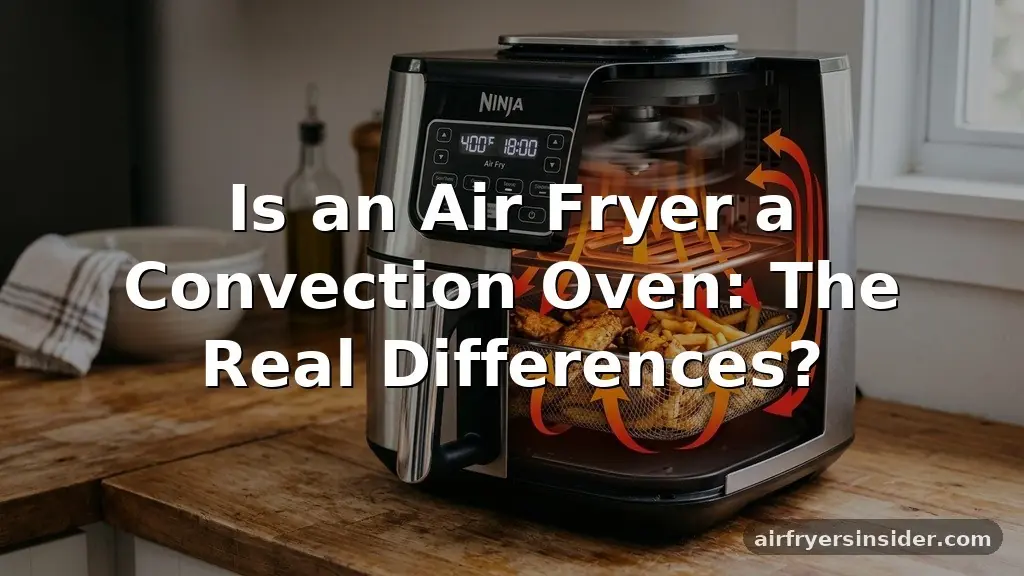
Many home cooks wonder if an air fryer is a convection oven in disguise because both appliances rely on moving hot air to cook food. While they share the same fundamental physics, the way they execute that process creates distinct results on your plate. Understanding these nuances helps you decide which tool best fits your daily cooking routine, whether you are crisping frozen snacks or roasting vegetables.
The Fundamental Physics of Air Circulation

At their most basic level, both air fryers and convection ovens operate on the principle of forced air circulation. A standard oven relies primarily on radiant heat from coils, which often creates hot and cold spots. A convection oven adds a fan to move that hot air around, helping to achieve more uniform temperatures throughout the chamber.
An air fryer takes this concept to the extreme. These devices are essentially high-powered, compact convection ovens.
The fan in an air fryer is typically much larger and more powerful relative to the size of the cooking chamber. This allows for incredibly rapid movement of thermal energy, which is why air fryers can achieve a crispy texture that traditional convection ovens often struggle to replicate without significantly longer cook times.
Comparing Cooking Speed and Efficiency
When looking at cooking speed and efficiency, the air fryer usually comes out on top. Because the chamber is small and the fan is positioned close to the food, the preheat time is almost nonexistent. You can often start cooking immediately, whereas a full-sized convection oven requires several minutes to reach the desired temperature.
For those who prioritize speed, energy efficiency, and ease of cleaning, the air fryer is a clear winner. It uses less electricity to heat a small space than a large oven does to heat a cavernous one. If you are just cooking a quick meal for one or two people, the energy savings over a year can be noticeable, making the air fryer a smart addition for busy households.
The Role of Texture and the Maillard Reaction
The Maillard reaction is the chemical process responsible for the browning and flavor development in cooked foods. In a traditional oven, moisture often builds up around the food, which can lead to steaming rather than crisping. Because an air fryer uses such intense forced air circulation, it quickly wicks away surface moisture.
This rapid evaporation is the secret behind the signature crunch of air-fried foods. By stripping away that thin layer of moisture, the surface of your food can reach the high temperatures necessary to trigger the Maillard reaction much faster. This is why air-fried chicken wings or roasted potatoes often have a texture superior to those prepared in a standard convection oven.
Design Differences: Basket vs. Oven Chamber
The physical design of these appliances is where the most obvious differences appear. An air fryer typically uses a basket design, which allows air to flow 360 degrees around the food. This setup is perfect for items that need even browning on all sides, such as french fries or breaded snacks.
Conversely, a convection oven uses trays or racks. While this is better for baking cookies or roasting larger cuts of meat, it can sometimes lead to uneven cooking if the airflow is blocked by large pans.
If you are trying to decide which device to use, consider the surface area you need. Air fryers are excellent for small, high-heat tasks, while convection ovens are better for batch cooking or items that require more room to breathe.
Practical Considerations for Home Cooks

Choosing between these tools often comes down to your kitchen footprint and your specific dietary habits. If you have limited counter space, a large convection oven might already be built into your range, making a standalone air fryer feel redundant. However, if you find yourself frequently reheating leftovers or cooking small portions, the air fryer offers a level of convenience that a full-sized oven cannot match.
Top Factors for Choosing Your Appliance
- Kitchen Footprint: Air fryers take up valuable counter space, while convection ovens are usually integrated into your range.
- Batch Size: Convection ovens handle large trays of food, whereas air fryers are limited by their basket capacity.
- Cleaning: Most air fryer baskets are dishwasher safe, making them easier to maintain than a full-sized oven interior.
- Heat Control: Air fryers reach peak temperatures in seconds, whereas ovens have significant thermal mass to overcome.
Addressing Common Misconceptions and Topical Gaps
A common point of confusion is whether you can use an air fryer as a convection oven for delicate baking. While it is technically possible, you have to be careful with the intensity of the fan. Because the air movement is so aggressive, it can sometimes blow light batters or loose toppings off your food before they have a chance to set.
Another gap in understanding involves temperature conversion. Because air fryers are so efficient, you often need to lower the temperature by about 25 degrees Fahrenheit compared to what a recipe calls for in a conventional oven. You should also check your food a few minutes early, as the high-velocity air can cook items significantly faster than expected.
| Feature | Air Fryer | Convection Oven |
|---|---|---|
| Preheat Time | Near-instant | 10-15 minutes |
| Airflow Intensity | Very High | Moderate |
| Best Use Case | Crisping, reheating, small batches | Baking, roasting, large meals |
| Cleaning Ease | High (Removable basket) | Low (Full oven clean) |
Versatility and Cooking Limitations
While both appliances can bake, roast, and reheat, gentle heat is required for certain recipes. Air fryers are not ideal for slow-cooking stews or delicate pastries that require a steady, non-turbulent environment. If you try to bake a soufflé in an air fryer, the powerful fan will likely disrupt the rise, leading to a collapsed dish.
However, for everyday tasks like reheating leftovers, the air fryer is vastly superior. It restores the original texture of fried foods or pizza in a way that a microwave or standard oven simply cannot. The combination of intense heat and airflow transforms soggy leftovers into something much closer to their fresh-cooked state.
The Future of Kitchen Appliance Design
We are seeing a convergence in the market where high-end ovens now include an “air fry” setting. These hybrid appliances use a more powerful fan and a redesigned heating element to mimic the performance of a standalone air fryer. This development suggests that the industry recognizes the value of the air-frying technique but wants to provide the space of a traditional oven.
Ultimately, whether you choose to invest in a dedicated air fryer or rely on a convection oven depends on your specific goals. If you value crispy textures and quick prep times above all else, a dedicated air fryer remains the gold standard. If you prefer a multi-purpose tool that can handle everything from a small snack to a Thanksgiving turkey, a convection oven with an air-fry mode might be the better long-term investment.
FAQ
Can I use an air fryer as a convection oven?
Yes, an air fryer is essentially a high-powered, compact convection oven. You can use it to roast, bake, and reheat most foods. Just be aware that the airflow is much stronger, so you may need to reduce the cooking temperature and time to prevent your food from drying out.
Is the food in an air fryer healthier than in a convection oven?
Both appliances are healthier than deep frying because they require very little oil. However, since they use the same physics, the nutritional outcome is generally the same. The main health benefit comes from using less fat to achieve a crispy texture that mimics traditional fried food.
Do I need an air fryer if I have a convection oven?
You might not need one if your convection oven is efficient and heats up quickly. However, an air fryer is often more convenient for small, daily tasks. It saves time on preheating and is much easier to clean, which can be a game-changer for quick weeknight meals.
Is 400 degrees in an air fryer the same as an oven?
While the temperature setting is the same, the cooking performance is not. The intense, concentrated airflow in an air fryer means food cooks faster and browns more aggressively at 400 degrees. Always monitor your food closely the first time you cook a recipe, as it will likely finish sooner.
Conclusion
Knowing that an air fryer is a convection oven at its core demystifies the appliance and helps you use it more effectively. While they share the same DNA of moving hot air, the differences in fan speed, chamber size, and heat intensity dictate how they perform in the kitchen. Whether you are aiming for that perfect crunch on your vegetables or simply trying to reheat pizza without it turning into a soggy mess, understanding these nuances allows you to get the most out of your equipment.
Experiment with your settings, keep an eye on your food as it cooks, and you will quickly master the art of forced-air cooking. We hope this clears up the confusion so you can get back to what matters—making great food.
Meta Description: Is an air fryer a convection oven? Learn the real differences in airflow, cooking speed, and texture to decide which kitchen appliance suits you.


