

Determining how long to cook a burger in an air fryer is the secret to achieving that elusive, restaurant-quality crust while keeping the interior succulent. Because air fryers rely on intense, rapid heat, getting your timing right prevents the common pitfalls of dry, overcooked meat or raw centers.
Whether you are working with fresh ground beef or frozen patties, the goal is consistent heat distribution that respects the integrity of the meat. By understanding the relationship between heat levels and patty thickness, you can master the art of the perfect air-fried burger without ever needing to stand over a smoking stovetop grill again.
Mastering Temperature and Timing Fundamentals
The fundamental rule for any air fryer recipe is that the device acts more like a high-powered convection oven than a traditional fryer. When you investigate how long to cook a burger in an air fryer, you must first acknowledge that your specific model—whether it is a compact basket-style air fryer or a larger oven-style air fryer—will influence the result.
Most cooks find that 375 to 400 degrees Fahrenheit is the sweet spot. At 400 degrees, you trigger the Maillard reaction rapidly, which is the essential chemical process that creates the deep, savory brown crust on the surface of your beef.
If you prefer a gentler cook, dropping the temperature to 375 degrees Fahrenheit can provide more control, especially for thicker patties that need time for the heat to penetrate the center without burning the exterior. Generally, a standard one-inch fresh beef patty will reach a medium-well internal temperature in roughly 8 to 12 minutes.
However, this is not a universal constant. The density of the grind, the fat content of the meat, and the initial temperature of the patty—whether it came straight from the fridge or sat on the counter for ten minutes—all play a significant role in the final outcome.
The Role of Patty Thickness in Cooking Success
Patty thickness is perhaps the most important variable when determining your cooking time. A thin, smash-style patty will obviously reach the desired internal temperature much faster than a thick, pub-style burger.
If you are forming your own patties from fresh ground beef, try to maintain a uniform shape. Irregular edges or lopsided thicknesses lead to uneven cooking, where one side of the burger is overdone while the other remains dangerously undercooked.
For a standard quarter-pound patty, aim for a thickness of about three-quarters of an inch. This allows for a solid sear on the outside while maintaining enough mass to hold onto its juices. If you are cooking thicker patties, you must increase your cooking time by 2 to 3 minutes and consider lowering the temperature slightly to ensure the middle doesn’t stay cold.
If you find your patties are curling up at the edges, try pressing a small indentation into the center of the raw patty with your thumb before it hits the basket. This simple trick prevents the burger from puffing up into a ball, ensuring it stays flat and cooks evenly across the entire surface.
Managing Frozen Patties Effectively
Many home cooks rely on frozen patties for a quick weeknight meal, and the air fryer is arguably the best tool for the job. You do not need to thaw your frozen beef patties before cooking, which is a major advantage over pan-frying.
When cooking from frozen, you should expect to add about 3 to 5 minutes to the total cooking time compared to fresh beef. Start by preheating your air fryer for at least three minutes; this ensures the initial heat blast is strong enough to sear the exterior immediately.
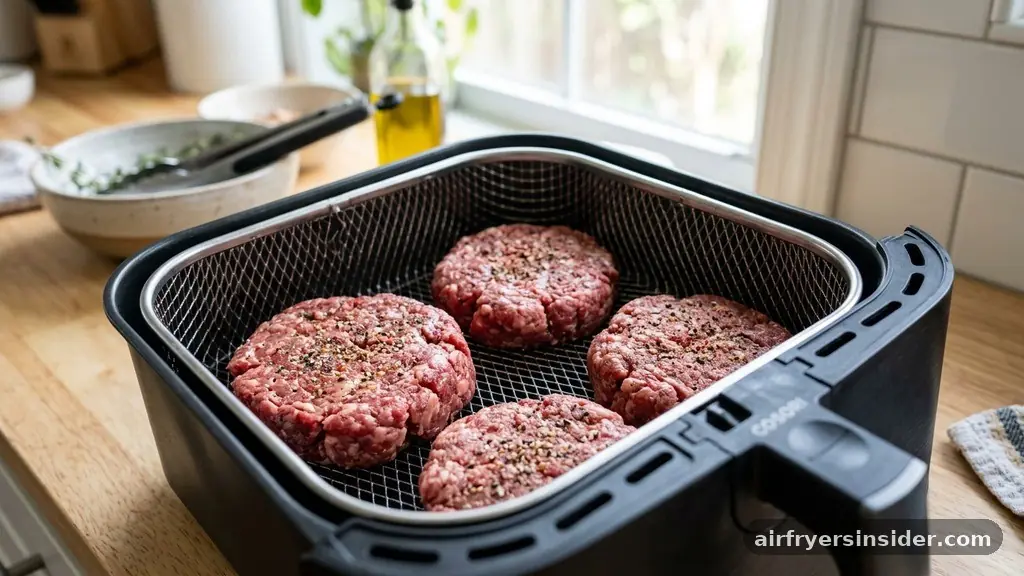
Because frozen patties are often moisture-heavy, the air circulation in the basket is vital. Avoid overcrowding the basket, as this traps steam and prevents the surface of the meat from browning properly. If you are cooking multiple burgers, arrange them in a single layer with enough space between them for the air to move freely.
If the air cannot circulate around the sides of the patty, you will end up with a steamed burger rather than a grilled one. Flip the frozen patties halfway through the process to ensure both sides get that essential crispy finish.
Why Preheating and Air Circulation Matter
Preheating is often dismissed as optional, but in the world of air frying, it is a technical necessity. When you drop a cold patty into a cold basket, the meat begins to release its juices and rendered fat before the Maillard reaction can even begin.
This results in a grey, unappetizing exterior. By preheating to 400 degrees Fahrenheit, you ensure that the moment the meat touches the basket, the surface begins to brown instantly.
Furthermore, air circulation is the mechanic that drives the cooking process. Basket-style air fryers are designed to force hot air down through the food and back up the sides. If you block this airflow by stacking food or using too much parchment paper, the temperature will fluctuate wildly.
If you choose to use parchment paper for easier cleanup, ensure it does not cover the entire bottom of the basket. Use a perforated version or cut a piece just large enough for the patties so that the air can still move around the edges. This simple adjustment ensures the heat reaches the bottom of the burger, providing a consistent crust on both sides.
Ensuring Food Safety with Internal Temperatures
Following USDA guidelines is non-negotiable when dealing with ground beef. Unlike a steak, which can be safely eaten medium-rare because bacteria are generally limited to the surface, ground beef mixes surface bacteria throughout the entire patty.
Therefore, the internal temperature is the only reliable way to measure doneness. A high-quality meat thermometer is your most valuable tool in the kitchen.
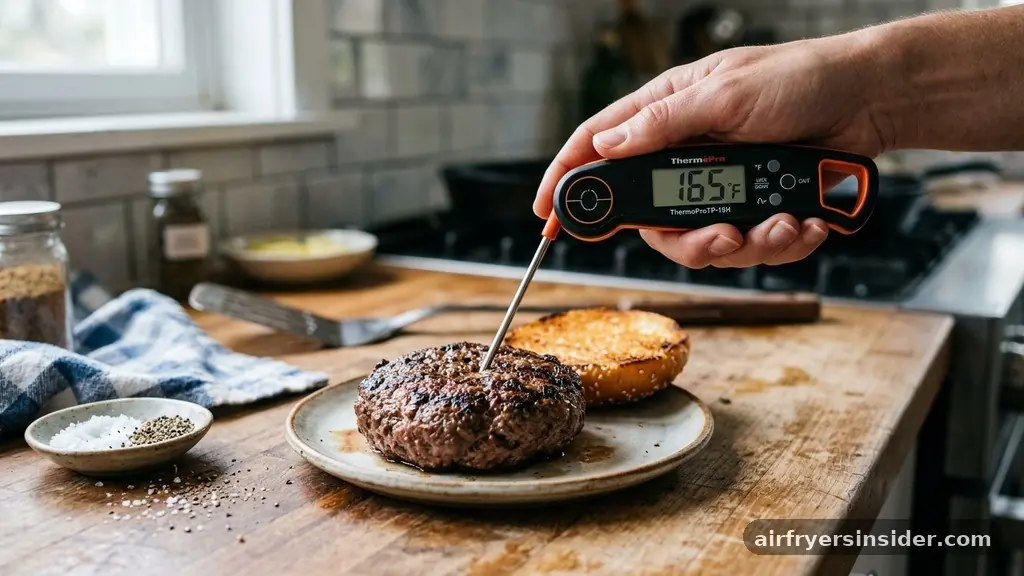
Insert the probe into the center of the thickest part of the patty. For ground beef, the USDA recommends an internal temperature of 160 degrees Fahrenheit to ensure all potential pathogens are eliminated. If you prefer a medium-rare burger, you are technically operating outside of standard safety guidelines, but many home cooks choose to aim for 145 degrees Fahrenheit for a pinker center.
Regardless of your preference, do not rely on visual cues like the color of the meat or the clarity of the juices. A meat thermometer provides objective data, taking the guesswork out of the process and ensuring your meal is both delicious and safe.
Comparison of Cooking Methods and Times
The following table provides a general baseline for cooking times based on patty type and thickness. Keep in mind that these numbers assume a preheated air fryer.
| Patty Type | Thickness | Estimated Time | Recommended Temp |
|---|---|---|---|
| Fresh Beef (Standard) | 0.75 inch | 8-10 minutes | 400°F |
| Frozen Beef | 0.75 inch | 12-15 minutes | 400°F |
| Thick/Pub Style | 1.25 inch | 14-18 minutes | 375°F |
| Turkey/Veggie Burger | 0.5 inch | 7-9 minutes | 370°F |
The Importance of Resting Time
After you pull your burgers from the air fryer, you might be tempted to serve them immediately, but resting is a critical final step. During the cooking process, the heat causes the muscle fibers in the meat to contract, pushing the rendered fat and juices toward the center of the patty. If you cut into the burger the second it leaves the basket, those juices will run out onto the plate, leaving you with a dry, lackluster bite.
Allow the burgers to rest on a plate or a cutting board for at least 3 to 5 minutes before placing them on a bun. During this time, the muscle fibers relax, allowing the juices to redistribute throughout the patty.
This simple pause ensures that every bite is as moist and flavorful as the first. Resting also provides a perfect window of time to toast your buns or prepare your toppings, making the final assembly of your burger much more efficient and professional.
Addressing Common Cooking Hurdles
Even with the best instructions, you may run into specific issues when cooking burgers in an air fryer. If your burgers are coming out too dry, the most likely culprit is overcooking or using beef that is too lean.
Ground beef with at least 20 percent fat is ideal for air frying; the fat renders out during the cooking process and keeps the meat moist. If you are using lean ground beef, you may need to reduce the cooking time by a minute or two.
Another common issue is smoke. If your air fryer begins to smoke, it is usually because the rendered fat has dripped onto the heating element at the bottom of the unit. To prevent this, you can place a small piece of bread or a shallow heat-proof tray at the very bottom of the air fryer, below the basket.
This catch-all will absorb the dripping fat and prevent it from burning. Additionally, ensure you are cleaning the basket thoroughly after each use, as old, burnt-on grease is the primary cause of excess smoke during subsequent cooking sessions.
Topical Gaps: Seasoning and Topping Strategies
A common question is when to apply seasoning. Unlike pan-frying, where you might season the pan, with an air fryer, you should season the patties directly. However, be cautious with dry rubs that contain high amounts of sugar, as they will burn quickly in the intense air circulation.
Stick to coarse salt and freshly cracked black pepper. If you want to add cheese, do so during the last minute of cooking.
Simply open the basket, place the slice on the patty, and close it back up. The residual heat and circulating air will melt the cheese perfectly onto the burger without it blowing away, which is a frequent problem in more powerful models.
- Use high-fat ground beef (80/20 ratio) for the best texture and moisture.
- Avoid overcrowding the basket to ensure proper air circulation and browning.
- Always use a meat thermometer to check the internal temperature, aiming for 160°F.
- Preheat the air fryer for at least 3 minutes for a better crust.
- Allow the burgers to rest for 5 minutes to keep them juicy.
- Place cheese on the burgers during the final 60 seconds of cooking.
- Use a small piece of bread at the bottom of the unit to catch grease.
Frequently Asked Questions
How do you know when a burger is done in an air fryer?
The only accurate way to determine doneness is by using a meat thermometer. Insert the probe into the thickest part of the patty. You are looking for an internal temperature of 160 degrees Fahrenheit to meet safety guidelines for ground beef, ensuring the center is fully cooked.
Can you cook frozen burgers in an air fryer at 400 degrees?
Yes, 400 degrees Fahrenheit is the ideal temperature for frozen patties. It provides enough heat to sear the exterior while cooking the frozen interior. Expect the process to take between 12 and 15 minutes, depending on the thickness of the patty, and always flip them halfway through.
Do I need to use oil when cooking burgers in an air fryer?
You generally do not need to add oil because ground beef contains enough natural fat. However, if you are using very lean meat, a light spray of olive oil can help with browning and prevent the surface from drying out too quickly during the cooking process.
How long should I flip the burgers?
You should flip the burgers once, halfway through the total cooking time. This ensures even browning on both sides and helps the patty cook uniformly. If you are using a basket-style air fryer, this is also a good opportunity to shake the basket gently or adjust the spacing if necessary.
Final Thoughts on Air-Fried Success
Mastering the air fryer for burgers is less about following a rigid manual and more about understanding how heat affects your specific choice of meat. By controlling the temperature, respecting the thickness of your patties, and utilizing a meat thermometer, you can consistently produce high-quality results that rival any traditional grill. Remember that the Maillard reaction is your friend, so don’t be afraid of a higher temperature, provided you monitor the internal progress of the beef.
Start with these guidelines, observe how your specific appliance handles the fat content of your chosen ground beef, and adjust your timing accordingly. Once you find that perfect balance, you will likely find that the convenience and consistency of the air fryer make it your go-to method for weeknight dinners. Enjoy experimenting with your favorite seasonings and toppings, and don’t hesitate to share your successful results with friends and family.
Meta Description: Learn how long to cook burger in air fryer for the perfect juicy result. Get tips on timing, temperature, and food safety for fresh and frozen patties.


