Mastering the art of using your kitchen appliances effectively can transform your leftovers from soggy disappointments into meals that taste fresh. Figuring out exactly how long to reheat food in air fryer settings often feels like guesswork, but once you understand the mechanics of convection heating, you can achieve perfect results every time.
By balancing time and temperature, you avoid the common pitfalls of dried-out edges or cold centers. This guide provides the specific techniques and timing needed to revive your meals while maintaining that desirable crispy texture, ensuring your leftovers are as enjoyable the second time around as they were on the first night.
Understanding Convection Heating for Reheating

The air fryer functions essentially as a powerful, compact convection oven. Unlike a microwave, which agitates water molecules to generate heat, the air fryer uses rapid air technology to circulate hot air around the food.
This process is far superior for reheating because it mimics the original cooking environment. When you reheat leftovers this way, the thermal circulation works to evaporate excess surface moisture while heating the interior, which is why fried foods regain their crunch.
Understanding this mechanism is key to knowing how long to reheat food in air fryer units. Because the heat source is concentrated and close to the food, the process is significantly faster than a traditional oven.
You are not just warming the dish; you are effectively re-roasting or re-frying it. This distinction is vital for maintaining food safety, as you must ensure the internal temperature reaches a level that destroys potential bacteria, typically around 165 degrees Fahrenheit, without incinerating the exterior.
The Microwave Comparison and Why Texture Matters
Many people struggle with the choice between a microwave and an air fryer. The microwave is undeniably faster, but it often sacrifices quality, leading to rubbery textures and uneven heating.
When you use a microwave, steam builds up inside the food, which is great for softening vegetables but terrible for anything that needs to remain crisp. An air fryer, by contrast, removes that excess steam, preserving the structural integrity of your meal.
This comparison highlights why the air fryer has become the gold standard for leftovers. While you might spend three minutes in a microwave for a piece of pizza, the result is often a limp crust. In an air fryer, you might spend five to seven minutes, but the crust becomes firm and the cheese bubbles perfectly.
The difference in reheat duration is a small price to pay for a meal that actually retains its original character. If you prioritize flavor and mouthfeel over sheer speed, the air fryer is the clear winner for almost every dish.
Essential Temperature Guidelines for Best Results
Temperature control is just as important as the duration of the heating process. If the temperature is too high, the outside of your food will burn before the center is warm.
If it is too low, you end up with food that is lukewarm and potentially dried out from the prolonged exposure to the fan. For most items, a temperature range between 320 and 350 degrees Fahrenheit is the sweet spot.
Consistency is key when you are learning how long to reheat food in air fryer appliances. You should treat the air fryer like a precision instrument. If you are reheating something dense, like a thick slice of lasagna, lower the temperature slightly and increase the time to allow heat to penetrate the core.
For thinner items like chicken wings or thin-crust pizza, higher heat for a shorter duration works best to create that signature crispy exterior. Always consider the thickness of the item when setting your timer.
Strategic Use of Parchment Paper and Accessories
Many users overlook the importance of accessories when managing their reheating process. Parchment paper, specifically designed for air fryers with perforations, can be a game-changer for cleanup and heat distribution.
It prevents smaller items from falling through the basket and makes removing delicate foods much easier. However, you must ensure the paper is weighed down by the food so it does not fly up into the heating element, which could pose a fire hazard.
Another useful tool is a crisping rack. If your air fryer basket is deep, using a rack can elevate your food, allowing air to circulate underneath.
This is particularly important for items that are prone to becoming soggy on the bottom, such as roasted vegetables or fried chicken. By lifting the food off the base of the basket, you ensure uniform thermal circulation, which reduces the need to flip the food halfway through the cooking cycle.
Practical Reheating Chart for Common Leftovers
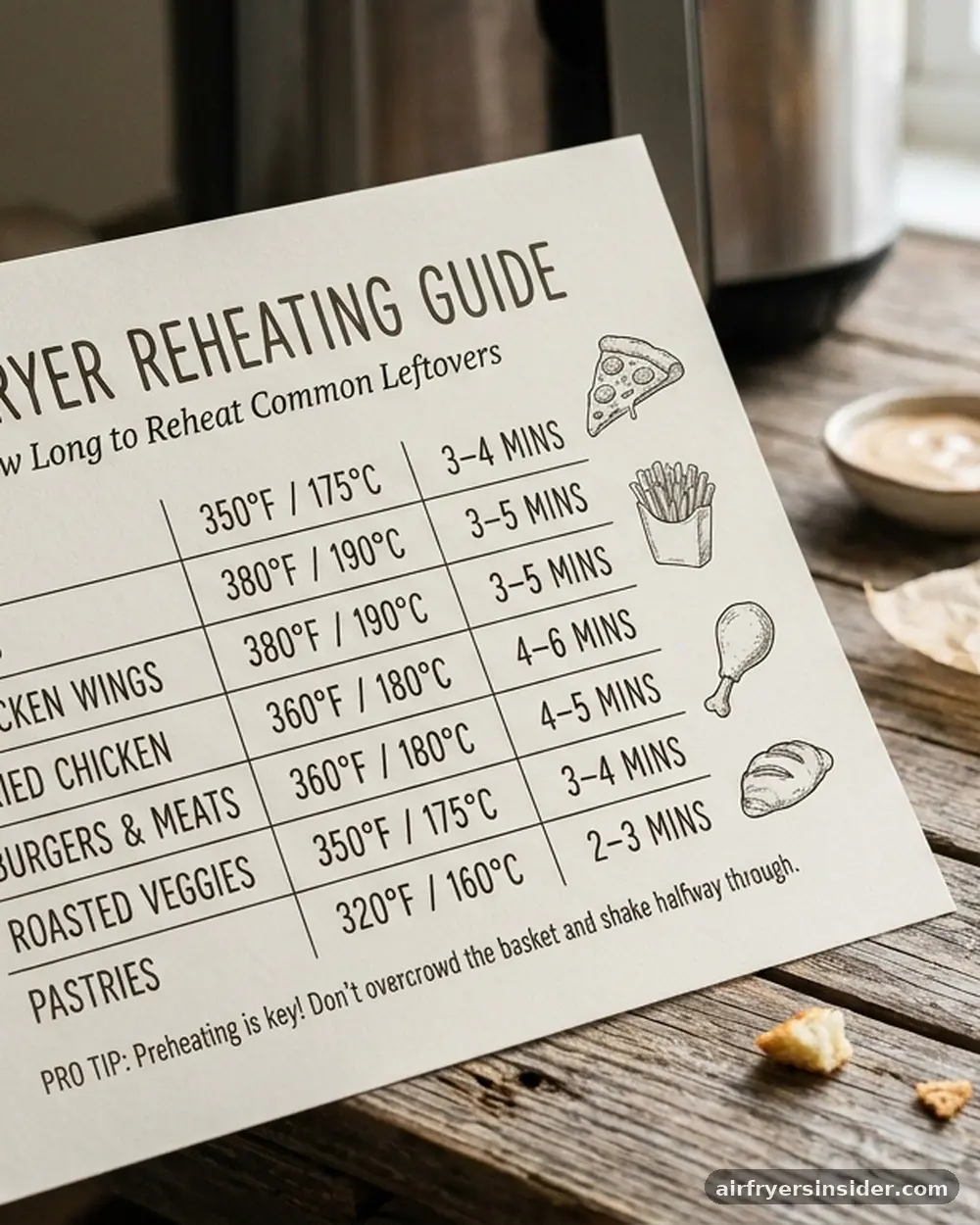
To simplify the process, refer to the following table. Keep in mind that wattage differences between models can influence how long to reheat food in air fryer units. If your machine is high-wattage, start at the lower end of the time range to avoid overcooking.
| Food Item | Temperature (F) | Estimated Time |
|---|---|---|
| Pizza (Thin Crust) | 350 | 4-5 Minutes |
| Fried Chicken | 375 | 6-8 Minutes |
| Roasted Vegetables | 340 | 5-7 Minutes |
| Steak Slices | 320 | 3-4 Minutes |
| French Fries | 380 | 3-5 Minutes |
Addressing Topical Gaps: Safety and Splatter
One common question that often goes unanswered is how to handle greasy foods without creating a massive mess. When reheating items like bacon or fatty proteins, the fan can pull grease into the heating element, causing smoke and potential fire. Using a splatter guard or simply placing a small piece of bread at the bottom of the basket can help absorb excess oil and prevent the dreaded smoking issue.
Additionally, many people worry about the internal temperature of reheated proteins. Food safety dictates that leftovers should reach 165 degrees Fahrenheit to be considered safe. Using a digital food thermometer is the only way to be certain.
If you are reheating a large portion, do not rely on time alone. Stick the probe into the thickest part of the food.
If it hasn’t reached the target, add one or two minutes at a time. This methodical approach is far safer than guessing.
Techniques for Preventing Dehydration
Dehydration is the enemy of quality leftovers. When you blast food with hot air, you are essentially drying it out. To combat this, you can use a light mist of food-grade oil.
A tiny amount of oil helps conduct heat more efficiently and adds a barrier that keeps the surface from becoming brittle. This is especially useful for breaded items or roasted potatoes that have lost their initial luster in the refrigerator.
Another trick involves using a tiny amount of residual moisture to your advantage. If you are reheating something like rice or a grain bowl, adding a teaspoon of water or broth before placing it in the air fryer can help create a steam effect that prevents the grains from turning into hard, crunchy bits. You want to strike a balance between the dry heat of the fryer and the moisture required to keep the food palatable.
Managing Wattage Differences and Preheating
Not all machines are built the same. A 1700-watt air fryer will reheat food significantly faster than a 1300-watt model. This is the primary reason why a single “universal” timing chart rarely works for everyone.
If you find your food is consistently burning on the outside before the inside is hot, your machine is likely running at a higher wattage than the recipe intended. Simply dial back the temperature by 25 degrees and add a minute or two to the duration.
Preheating is another variable. While many people skip it, preheating your air fryer for just two or three minutes can make a massive difference.
It ensures that the environment is at the correct temperature from the moment the food enters the basket. This consistency prevents the food from sitting in a warming chamber while the air slowly heats up, which can cause the food to lose its texture before the crisping process even begins.
Troubleshooting Common Reheating Issues
If your food comes out uneven, you are likely overloading the basket. Air fryers rely on the movement of air to cook. If the basket is packed too tightly, that air cannot flow between the pieces, leading to cold spots and soggy patches.
Always arrange your food in a single layer with enough space for air to move freely around each piece. If you have a large amount of leftovers, it is always better to reheat in two smaller batches than one large, crowded one.
If you encounter thermal shock—where the outside of a frozen or very cold item becomes hard while the middle stays frozen—you need to change your strategy. Always let your food sit on the counter for ten minutes to take the chill off before putting it in the air fryer.
This small step allows the heat to penetrate more evenly, resulting in a much better final product. If you are in a rush, a lower temperature for a longer time is the safest way to avoid the exterior hardening prematurely.
Frequently Asked Questions
Is it better to use an air fryer or a microwave for leftovers?
An air fryer is significantly better for maintaining texture, especially for crispy or fried foods, as it removes moisture rather than adding it. Microwaves are faster but often result in soggy or rubbery food, making them better suited for soups or items where moisture retention is desired.
Do I need to preheat my air fryer before reheating?
While not strictly required, preheating for two to three minutes ensures that the air is at the target temperature immediately. This helps in achieving a consistent, crispy finish and prevents the food from drying out during the initial ramp-up period of the heating cycle.
How can I tell if my food is safe to eat after reheating?
The most reliable method is using a food thermometer to check the internal temperature. For most leftovers, the food should reach an internal temperature of 165 degrees Fahrenheit. This ensures that any potential bacteria have been neutralized during the reheating process, making the meal safe to consume.
Can I reheat multiple types of food at once?
You can, provided they have similar cooking times and temperature requirements. However, be mindful of flavor transfer. If you are reheating something aromatic, like fish, it is best to do it separately from more delicate items like bread or vegetables to avoid cross-contamination of flavors.
Conclusion
Learning how long to reheat food in air fryer appliances is a skill that pays off with every meal. By focusing on temperature management, avoiding overcrowding, and using the right accessories, you can ensure that your leftovers are never a compromise. Whether you are reviving a slice of pizza or heating up last night’s roasted vegetables, the principles of rapid air circulation remain your best tools for success.
Start with the suggested times in this guide and adjust based on your specific appliance’s power. With a little practice, you will find that your air fryer is the most valuable tool in your kitchen for reducing waste and enjoying great-tasting food time and time again. Share your favorite reheating tips in the comments below and let us know how your meals turned out.
Meta Description: Learn how long to reheat food in air fryer settings for perfect results. Master temperature and timing to keep your leftovers crispy and delicious.