Many homeowners worry about their rising utility bills, and it is natural to wonder if modern kitchen gadgets like an air fryer use a lot of electricity during daily meal preparation. While these compact countertop devices have become staples in many kitchens, their actual impact on your monthly expenses depends on several technical factors.
By looking at how these appliances function compared to traditional cooking methods, you can determine if they truly offer energy savings or if they are just another drain on your resources. Understanding the relationship between power ratings and your actual usage patterns is the key to managing your home’s electrical load effectively.
Understanding Appliance Wattage and Energy Consumption
To determine the true impact on your household finances, you must first look at the appliance wattage. Most air fryers operate between 1,200 and 1,800 watts, which might sound high compared to smaller gadgets like a blender.
However, the total energy consumption is not just about the power draw; it is heavily influenced by the duration of use. Because air fryers are smaller than standard ovens, they reach the required temperature much faster, meaning they spend less time running at maximum power.
When you calculate your energy usage, you are measuring kilowatt-hours, or kWh. A 1,500-watt air fryer running for 30 minutes consumes approximately 0.75 kWh. If your local utility rates are around 15 cents per kWh, a single cooking session costs roughly 11 cents.
This relatively low cost per session highlights why these devices are often marketed as energy-efficient alternatives to larger, slower cooking methods. The internal mechanics, specifically the heating element and the high-speed convection fan, work in tandem to cook food quickly, which naturally limits the total time the device pulls power from your wall outlet.
Comparing Air Fryers to Conventional Ovens
The most common comparison involves the traditional convection oven. A full-sized oven has a much larger cooking capacity, which requires significantly more energy to preheat and maintain an even temperature throughout the entire cavity.
While an air fryer is essentially a high-powered, compact convection oven, its small size allows it to heat up in seconds rather than the ten to fifteen minutes often required for a conventional oven. This lack of a lengthy preheating phase is where the bulk of the potential energy savings are found.
If you are cooking a small batch of chicken wings or frozen vegetables, using an oven is often inefficient because you are heating a large, empty space unnecessarily. The air fryer directs heat precisely at the food, minimizing heat loss and maximizing thermal insulation.
By choosing the right tool for the job, you effectively reduce your electrical load. The following table provides a rough comparison of energy usage across common kitchen appliances to help you visualize the differences in consumption during a standard 30-minute cooking cycle.
| Appliance | Average Wattage | Est. Energy Use (30 mins) |
|---|---|---|
| Air Fryer | 1,500 W | 0.75 kWh |
| Electric Oven | 3,000 W | 1.50 kWh |
| Microwave | 1,000 W | 0.50 kWh |
| Toaster Oven | 1,200 W | 0.60 kWh |
The Role of Convection Fans and Heat Distribution
The secret behind the air fryer’s speed is the integration of a powerful convection fan. This component forces hot air to circulate rapidly around the food, creating a layer of intense heat that cooks the surface quickly.
This process is known as the Maillard reaction, which gives food that signature crispy texture without requiring deep frying. Because the air circulation is so efficient, you can often lower the cooking temperature by 25 degrees Fahrenheit compared to a standard oven recipe, which further reduces the energy draw.
This efficient air movement means that food cooks more evenly without you having to rotate trays or flip items as frequently. When you consider the total electricity cost, the combination of shorter cooking times and lower temperature requirements makes a compelling case for the air fryer.
Even though the fan itself consumes a small amount of power, it is negligible compared to the energy required to heat the internal air. By optimizing heat transfer, the appliance ensures that almost every watt of electricity is used for cooking rather than heating the surrounding air in your kitchen.
Addressing Topical Gaps: Real-World Usage Myths
Many users ask if an air fryer will cause their electric bill to skyrocket if they use it every day. In reality, the cumulative effect of using an air fryer for 30 minutes daily is quite modest for the average household. If you use it for 15 hours a month at a rate of 0.75 kWh per session, you are looking at approximately 11.25 kWh of total usage.
At current national average rates, this adds less than two dollars to your monthly bill. The concern that these devices are massive energy hogs is largely a misconception rooted in the high wattage rating rather than actual consumption metrics.
Another common gap in understanding involves the “Energy Star” label. While many large appliances carry these ratings to prove their efficiency, smaller countertop devices like air fryers generally do not qualify for or require such certification. This does not mean they are inefficient; it simply means they fall into a different category of household appliances.
You should focus less on finding an “Energy Star” air fryer and more on the cooking capacity that fits your family’s needs. A unit that is too small might force you to cook in multiple batches, which doubles your energy usage, whereas a properly sized unit gets the job done in one go.
Optimizing Your Cooking Routine for Energy Savings
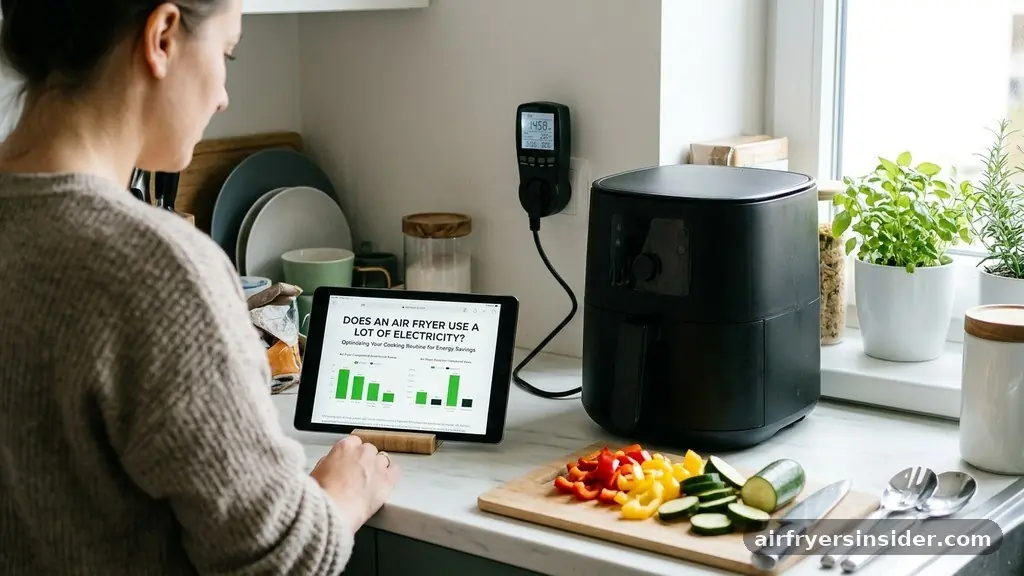
If you want to maximize your energy savings, start by managing your preheating habits. While many manufacturers suggest preheating, most air fryers reach their target temperature so quickly that you can often skip this step entirely for many types of food.
Simply add an extra minute or two to your total cooking time instead. This minor adjustment prevents the appliance from running while empty, saving you a fraction of the energy cost every time you cook.
Another way to improve efficiency is to avoid overcrowding the basket. When you pack the basket too tightly, the air cannot circulate effectively, which forces you to cook the food for much longer to achieve the desired texture. This increases the total electricity consumption per meal.
Instead, cook in single layers or use a rack accessory to improve airflow. By keeping the circulation path clear, you allow the convection fan to work at peak efficiency, ensuring your food is ready in the shortest time possible.
- Avoid preheating whenever the recipe allows for it.
- Don’t overcrowd the basket, as this restricts airflow and increases time.
- Clean the heating element regularly to prevent debris from blocking heat.
- Use the correct temperature settings to avoid over-cooking.
- Consider the capacity of the unit relative to the number of people you are feeding.
- Check the seal of the unit to ensure heat isn’t escaping.
The Relationship Between Peak Demand and Your Bill
Utility companies often charge different rates based on peak hours. If you are cooking during these high-demand times, your electricity might technically cost more depending on your specific utility plan.
However, because an air fryer is a relatively low-load appliance compared to central air conditioning or a clothes dryer, it is unlikely to trigger a significant spike in your bill even during peak hours. The real danger to your budget is the simultaneous use of multiple high-wattage kitchen appliances.
If you are running the air fryer, the electric kettle, and the toaster oven at the same time, you are putting a significant electrical load on your kitchen circuit. This can lead to tripped breakers, but it also means you are pulling a large amount of power at once.
By staggering your cooking tasks, you keep your electrical usage steady and manageable. This practice is a smart habit regardless of which appliances you use, as it reduces the strain on your home’s wiring and keeps your energy usage patterns consistent.
Comparing the Air Fryer to the Microwave and Toaster Oven
It is helpful to weigh the air fryer against other common small appliances. A microwave is technically more energy-efficient than an air fryer because it uses electromagnetic waves to heat water molecules directly, rather than heating the air.
However, microwaves cannot achieve the crispy, roasted results that define air frying. If you are just reheating leftovers, the microwave remains the king of efficiency, but for cooking raw proteins or frozen snacks, the air fryer is almost always the superior choice.
A toaster oven is a close competitor to the air fryer. While they share similar heating mechanisms, the air fryer’s fan-driven circulation usually makes it faster for tasks like roasting vegetables or cooking frozen items. Because the air fryer is typically smaller and better insulated, it often edges out the toaster oven in terms of pure efficiency for small batches.
If you are deciding which appliance to prioritize, consider the type of food you eat most often. If you prefer crispy, fried-style textures, the slight increase in energy usage compared to a microwave is a worthwhile trade-off for the quality of the meal.
Maintenance and Long-Term Efficiency
Your air fryer’s efficiency will degrade over time if you do not maintain it properly. A dirty heating element or a fan clogged with grease will force the motor to work harder and the heating element to stay on longer to reach the desired temperature.
This directly increases your electricity consumption. Make it a point to wipe down the interior and clean the fan blades periodically to ensure the air circulation remains unobstructed.
Also, pay attention to the condition of your air fryer’s door or basket seal. If the seal is loose or damaged, heat will leak out, causing the appliance to cycle its heating element more frequently to compensate for the temperature drop.
This is a common but overlooked cause of increased power usage. Simple maintenance tasks, such as checking the seals and keeping the unit clean, ensure that the appliance operates as efficiently as it did on the day you bought it, keeping your energy costs as low as possible.
Addressing Concerns About Power Ratings
When shopping for a new unit, you might feel tempted to buy the most powerful model available, thinking it will cook faster. While a higher wattage rating—say, 1,800 watts versus 1,400 watts—does mean the unit can generate more heat, it also means a higher instantaneous power draw.
For most home cooking, the difference in speed between a 1,400-watt and an 1,800-watt model is negligible. You are better off choosing a model with high-quality airflow design rather than just looking at the raw power rating.
Ultimately, the best way to keep your energy usage in check is to be mindful of your habits. Don’t worry about the appliance’s wattage as much as you worry about the total cooking time. An air fryer is an incredibly efficient tool for small to medium-sized meals.
If you use it correctly, it will likely reduce your total energy footprint compared to relying on a large electric oven. By integrating these practices into your kitchen routine, you can enjoy the convenience of modern cooking without worrying about the impact on your monthly electric bill.
Frequently Asked Questions
Does using an air fryer daily significantly increase my electric bill?
Using an air fryer daily for standard meal preparation will have a negligible impact on your monthly electric bill. Because the cooking times are short and the unit is compact, the total energy consumption remains low, likely adding only a couple of dollars to your monthly costs.
Is it cheaper to use an air fryer than a traditional oven?
Yes, it is generally cheaper to use an air fryer than a full-sized electric oven. The air fryer requires no long preheating time and uses less power to maintain heat in its smaller cavity, making it more energy-efficient for most small-to-medium cooking tasks.
Should I worry about the high wattage rating of my air fryer?
You do not need to worry about the high wattage rating. While the number seems large, the appliance runs for a very short duration compared to other kitchen appliances. The total energy usage is determined by the time spent cooking, not just the peak power draw.
Does an air fryer use more electricity than a microwave?
An air fryer typically uses more electricity than a microwave. Microwaves are highly efficient at heating food quickly, while air fryers consume more energy to power the heating element and convection fan. However, air fryers provide better textures that microwaves cannot replicate for many food types.
Final Thoughts on Energy Consumption
Determining whether an air fryer uses a lot of electricity requires looking at your specific usage habits rather than just the device’s power rating. While these appliances have high wattage, their ability to cook food rapidly and efficiently often results in lower total energy consumption compared to conventional ovens. By avoiding unnecessary preheating, keeping the basket clear for airflow, and maintaining the unit’s cleanliness, you can ensure that your cooking remains as cost-effective as possible.
If you are looking to balance convenience with energy savings, the air fryer is a reliable addition to your kitchen. Start monitoring your cooking times and you will quickly see that this modern tool is a smart, efficient choice for your home.
Meta Description: Does an air fryer use a lot of electricity? Discover the truth about wattage, energy efficiency, and how it compares to your oven and microwave.